GOOGLE ADS · SIGNAL FEED

See the signal.Cut the waste.Scale what wins.

The operational command center for teams buying traffic on Google Ads — account health, spend, revenue, approvals and risk across every account, in one view.

  • Your own Google Ads script and postbacks
  • AdsTracker holds no Google credentials and never signs in
  • One script into Google Ads, no spreadsheets
  • Realtime Monitoringaccounts report every hour
  • Threshold and anomaly rulesyour thresholds, plus a per-account baseline
  • Winning Advantagefind winners, scale faster
SIGNAL OVERVIEWLast 24 Hours

Active Signals

142+18.6%

Hot Alerts

23+31.2%

Engagement

87.4K+22.7%

ROAS Potential

High
Peak engagement detected
TOP SIGNALSView all
  • Eco Bottle 50% OffUS · Shopify12.4K+32.5%
  • Wireless EarbudsUS · TikTok9.7K+28.1%
  • Smart Watch X1UK · Facebook8.1K+19.3%
GEO HEATMAP
  • High
  • Medium
  • Low
  • You send the dataStats reach AdsTracker from a script you paste into your own Google Ads account, plus the postbacks you point at it. AdsTracker holds no Google credentials and never signs in.
  • Organization isolationEach tenant's data is fully partitioned. No cross-org leakage, enforced at the data layer.
  • Alerts where you already areAnomalies reach you in Telegram and the app inbox, with a browser push for the critical ones — no dashboard to keep open all day.
  • Built in the openWe name our limits rather than hide them: no email channel, no public API, no access to your Google Ads account.

The status quo

Media buying breaks when signals are scattered.

At scale, the difference between a winning campaign and a quiet loss is whether you can see it in time. Across hundreds of Google Ads accounts, fragmented tooling hides exactly the signals that matter.

  • Spend waste is hidden

    Budgets bleed across hundreds of accounts before anyone notices the underperformers dragging ROI down.

  • Accounts go silent

    A profile stops reporting and the first signal you get is missing revenue — not an alert that something broke.

  • Approvals slow teams down

    Disapprovals and limited ads pile up in places no one is watching, stalling launches for days.

  • Everything lives apart

    Domains, proxies, buyers, and finance each sit in their own tool, so no one sees the full picture at once.

Command center

One place for accounts, spend, risk, and action.

Stop stitching together spreadsheets and tabs. Every Google Ads account's health, money and signals land in a single operational view.

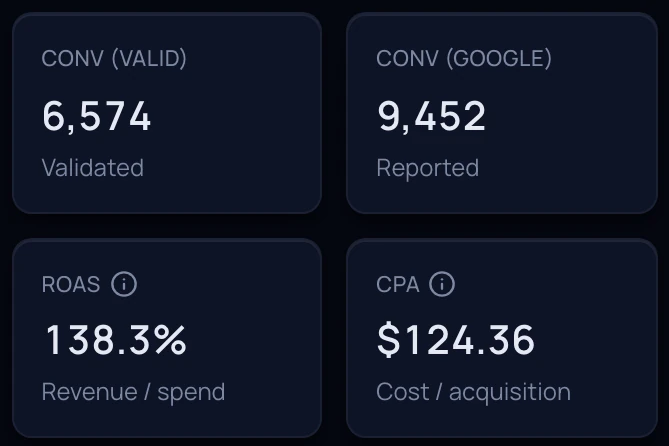
  • Spend, revenue, ROAS and CPA across every account in one view.
  • Status, approvals and at-risk accounts surfaced before they cost you.
  • Filter by segment, drill into a profile, and act without leaving the page.
app.ads-tracker.com/dashboard

Spend

$48.2k

+6.4%vs prev period

Revenue

$121.5k

+11.2%vs prev period

ROAS

2.52x

+0.18xvs prev period

CPA

$24.10

-3.1%vs prev period

Sample account performance — illustrative data only.
AccountStatusSpendROAS
Aurora Media — USActive$12.4k3.10x
Northwind — EUActive$9.8k2.74x
Helio PerformanceLimited$6.2k1.92x
Vertex Buyers — UKActive$5.5k2.40x
Cobalt Reach — LATAMPaused$0.0k
Alerts2 accounts went silentApproval rate dipped to 91%

Illustrative sample data. Live figures come from your synced accounts.

Signal detection

Eight kinds of problem, on your thresholds.

Every connected account reports in every hour, and each rule you set is re-checked every 15 minutes. The alert names the rule that fired and the account it fired on.

  • Cost per lead left its range

    P1

    anomaly · against the account’s own 7-day baseline

    +38%
  • The script went quiet

    P1

    script_silent · no report for 3 hours

    6 h silent
  • Spending, nothing coming back

    P1

    zero_conversions · spend past $50

    0 conv
  • Approval rate below your floor

    P2

    approval_drop · under 80%

    71%
  • An account went down

    P3

    account_banned · status turned suspended

    suspended

How it works

See the signal. Cut the waste. Scale what wins.

1See the signal

Every account, one live pulse.

Signal Scout watches spend, revenue and risk in real time and surfaces the anomaly the moment it appears.

Anomaly detected
2Cut the waste

Stop the spend that isn't working.

Wasted budget drops as soon as you act — one clear view turns noise into a decision.

23%Wasted spend
3Scale what wins

Pour fuel on the winners.

ROAS climbs as you double down on the campaigns the signal proved out.

3.4×ROAS climbing

The product

This is the actual application.

Not a rendering of it. Seven screens from the running product — what you watch, what it tells you, where the money lands, and how it reaches you away from the desk.

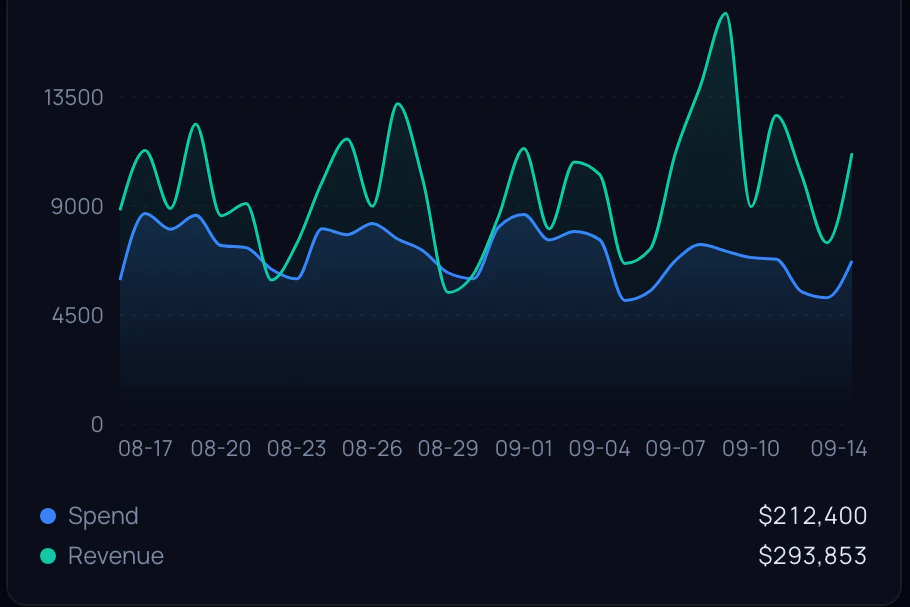
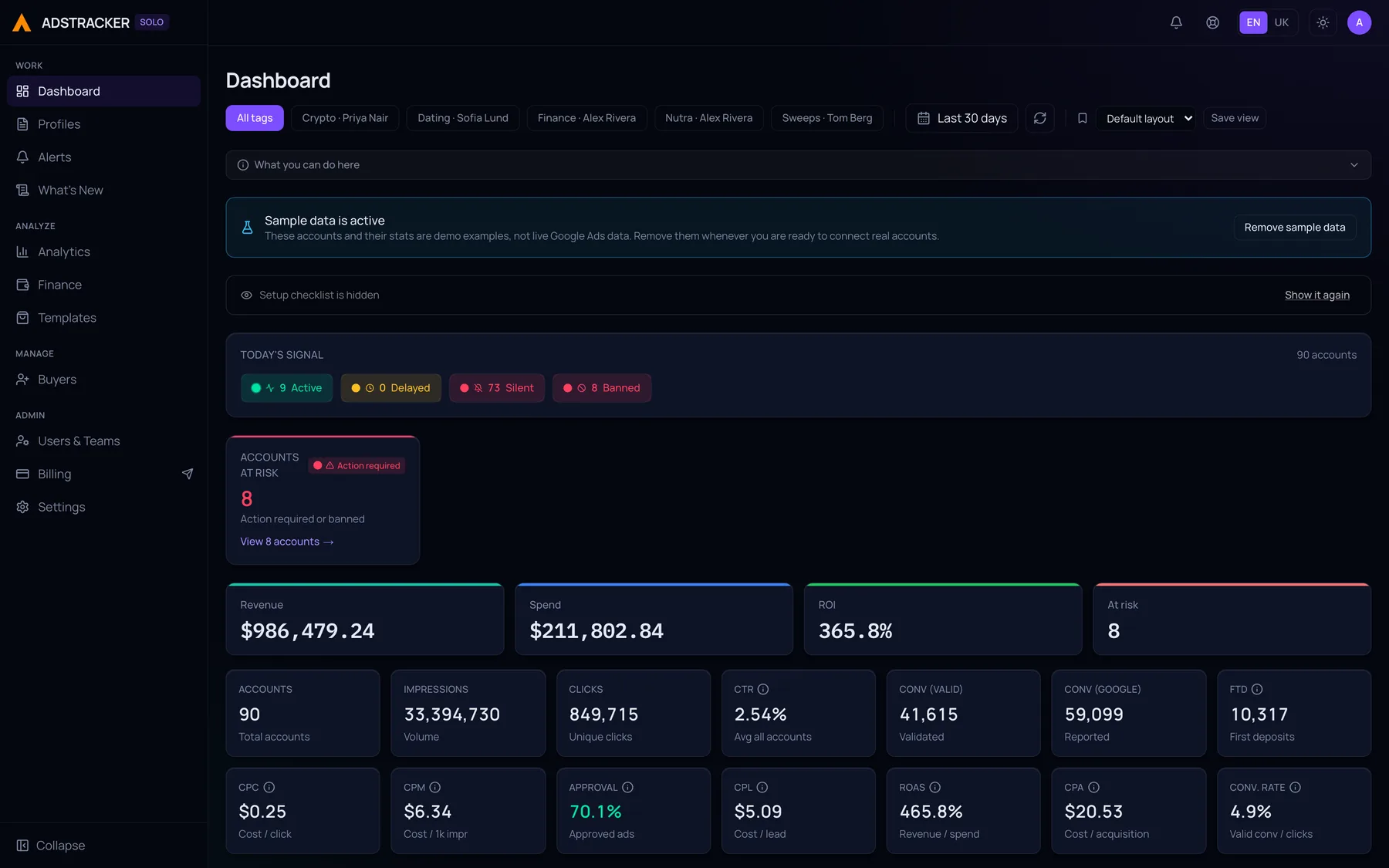
The AdsTracker dashboard showing spend, revenue, ROI, ROAS and cost per click across every account, with daily trend charts

The dashboard

Spend, revenue, ROI, ROAS, CPC, CPM and CPA across every account you have, over the range you pick.

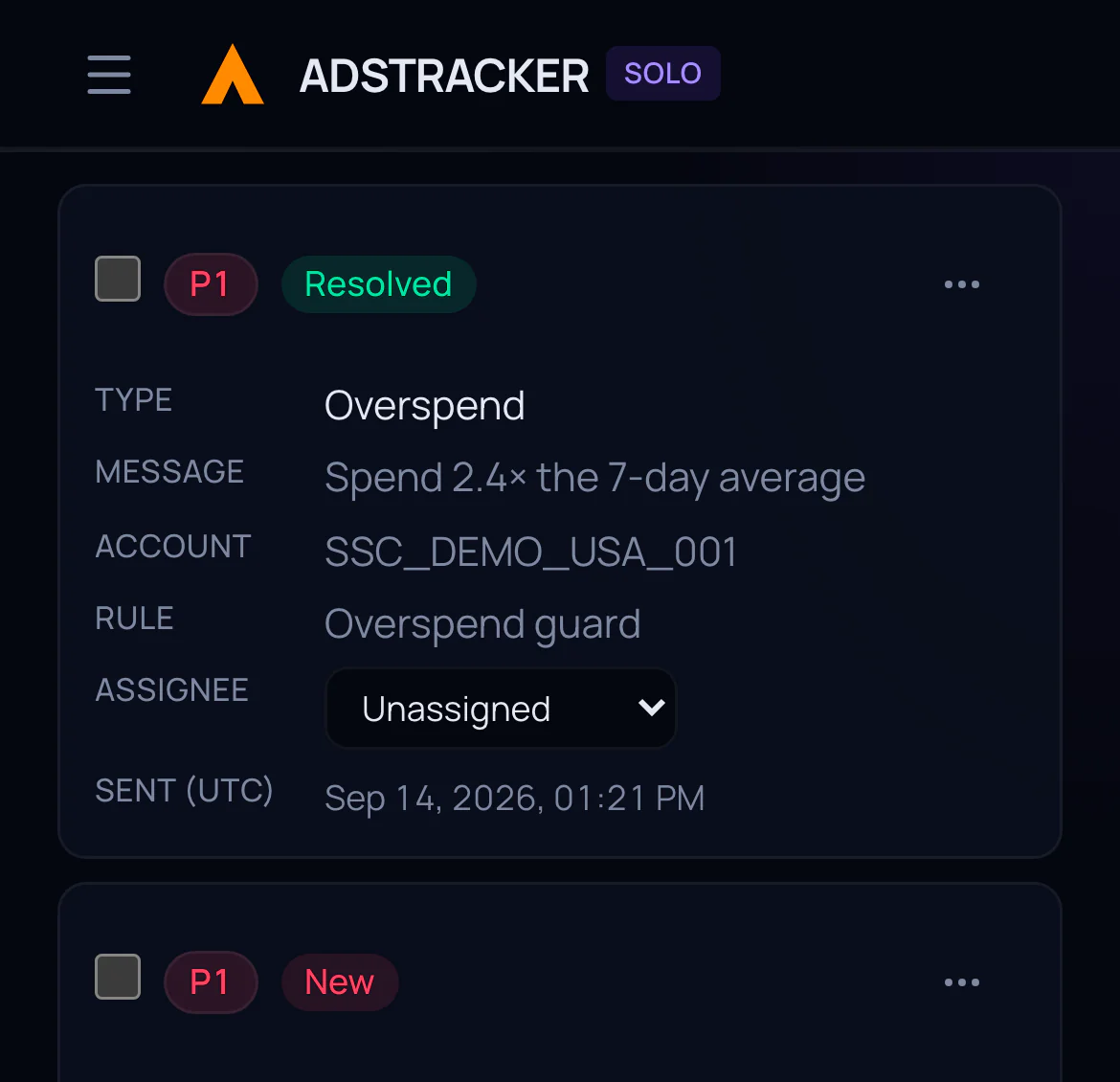
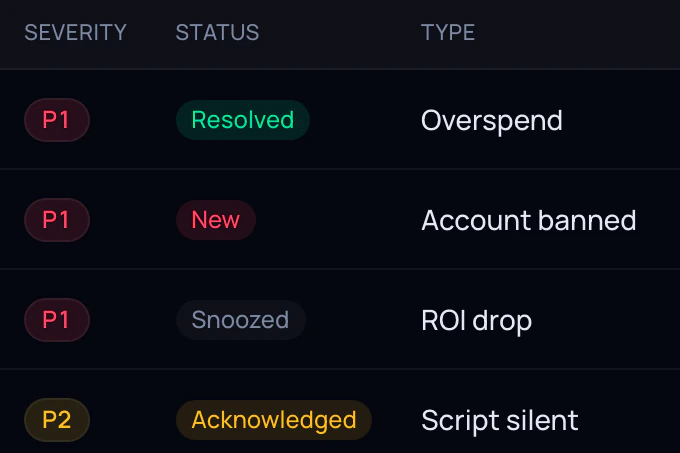
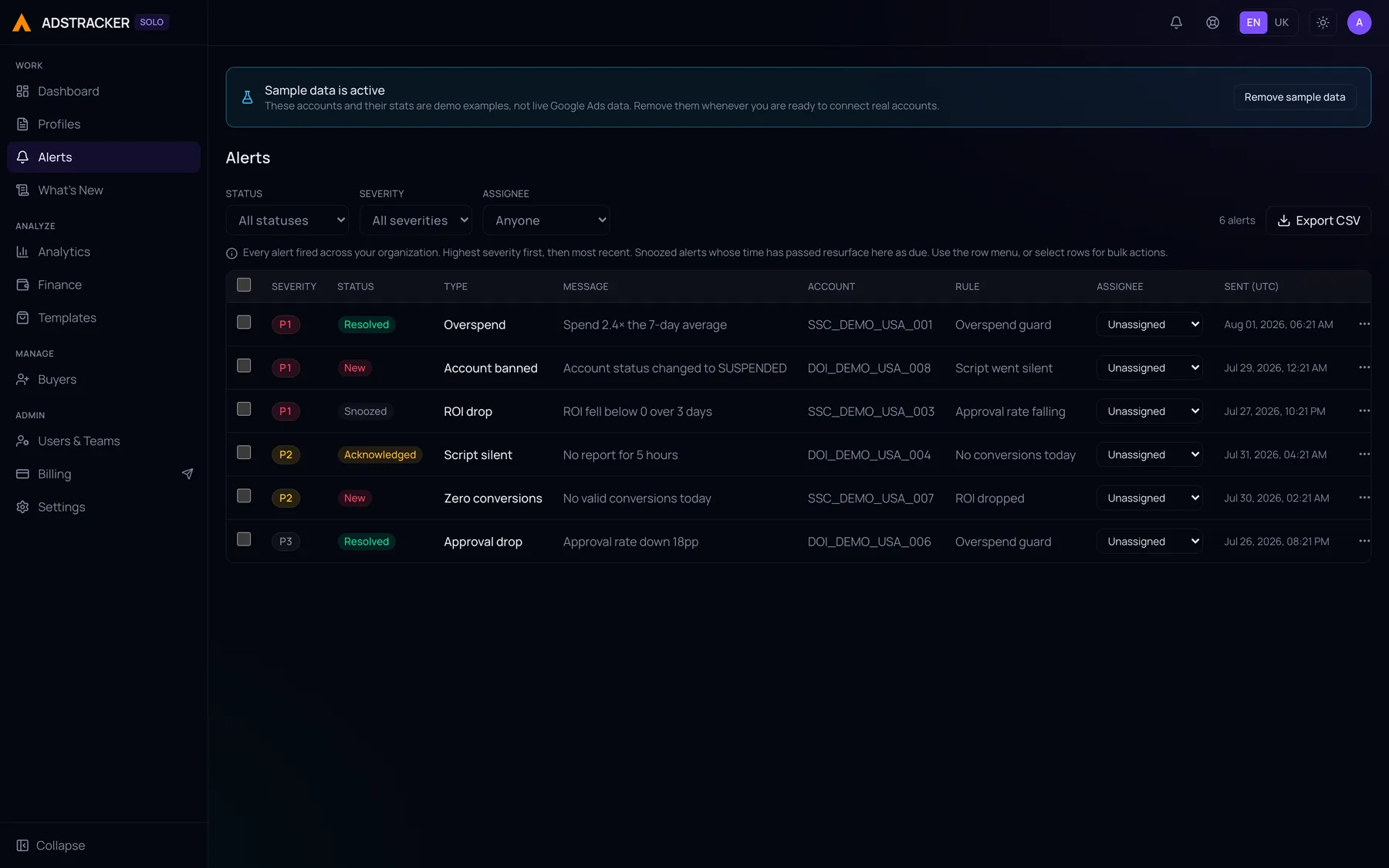
The alert inbox listing alerts with P1, P2 and P3 severities, their rules, statuses and assignees

The alert inbox

Every alert with the rule that fired it, its priority, who it is assigned to, and whether it is new, acknowledged, snoozed or resolved.

The accounts table with status, running campaigns, budget, cost, cost per lead, revenue and ROI per account

Every account in one table

Status, running campaigns, budget, cost, cost per lead, revenue and ROI — per account, with a total across all of them.

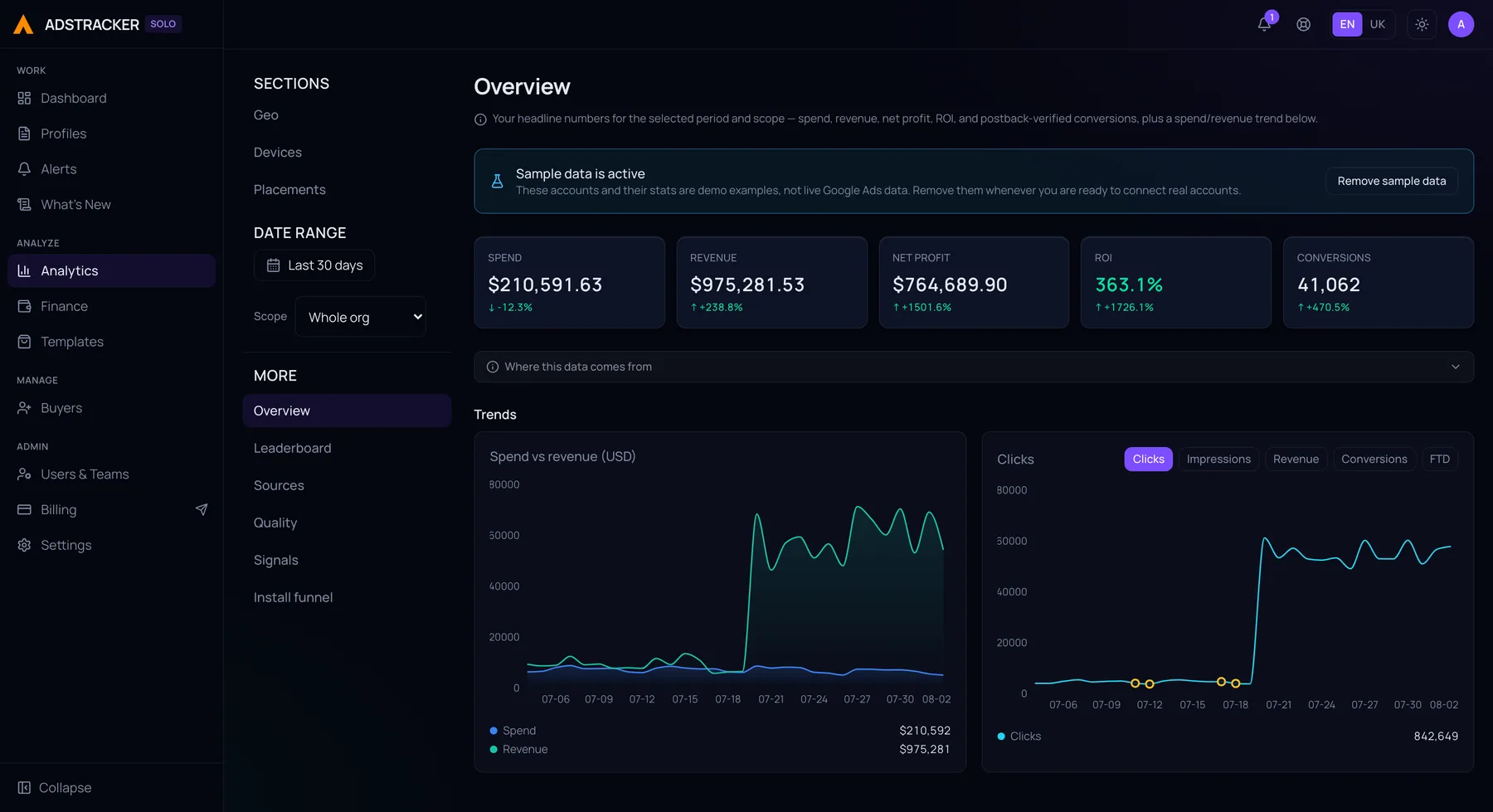
The geo analytics view with a world map and a table of top countries by spend

Where the money goes

Spend by country, on a map and in a table. Sources, devices, placements and traffic quality each get their own view.

The leaderboard view with top and worst ROI, top revenue, top net profit, money drain and dead scripts

What is winning and what is bleeding

Best and worst ROI, top revenue, top net profit — and the two lists nobody else builds: money drain and dead scripts.

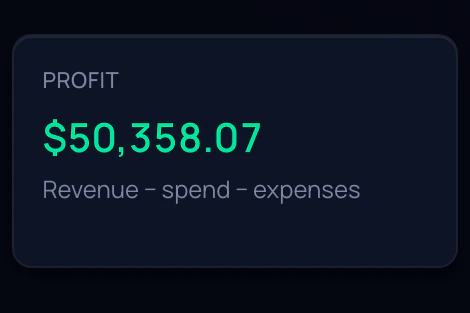
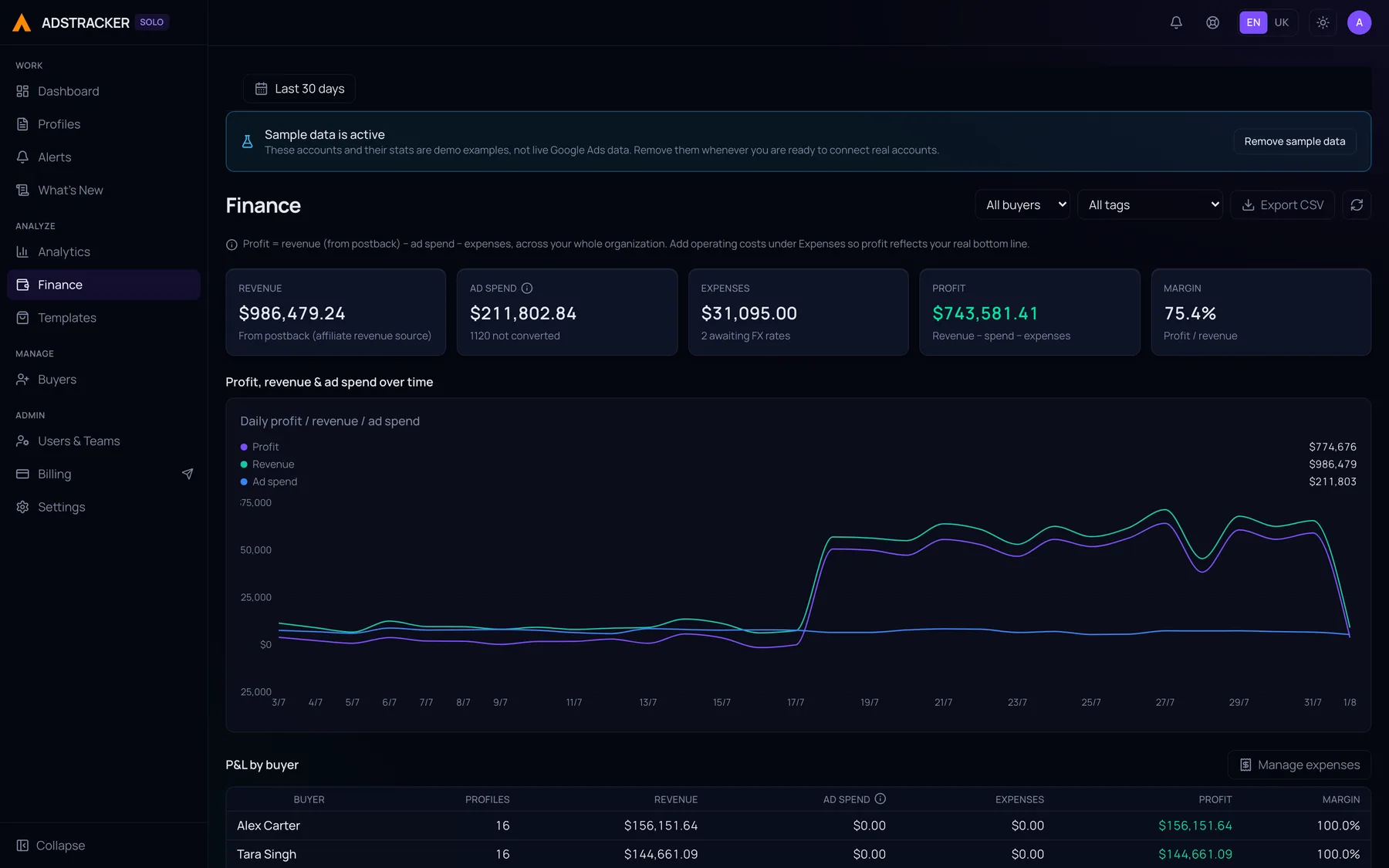
The finance section with revenue, ad spend, expenses, profit and margin, a daily chart and a profit and loss table by buyer

The P&L, per buyer

Revenue, ad spend, the expenses you enter by hand, profit and margin — then the same broken down by the person who spent it.

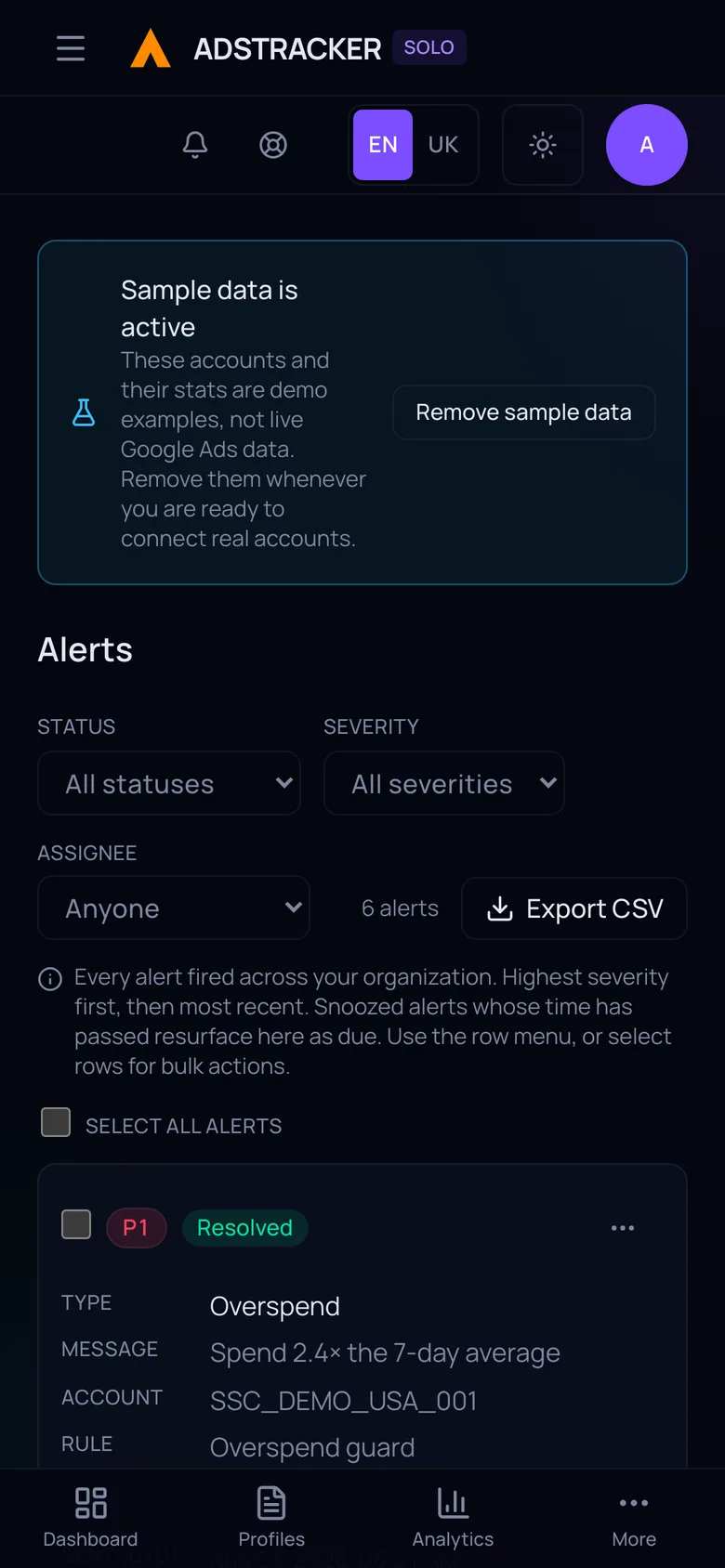
The alert inbox on a phone, in the installed app

On the phone

Installs from the browser on Android and iOS, with its own bottom navigation. Browser push carries the critical alerts to the device.
Every figure in these screens is sample data, and the product says so itself — its own sample-data banner is inside each frame. One click loads that workspace, and one click removes it.

Modules

Every part of the operation, covered.

Eight focused modules that work together — from the first synced account to the monthly P&L.

  • Dashboard

    Aggregate spend, revenue, ROAS and account health at a glance.

  • Profiles

    Filter, search and manage every Google Ads account in one table.

  • Buyers

    Group accounts by media buyer and track performance per person.

  • Analytics

    Geo, sources, devices, placements, creatives and traffic quality, per account or across the org.

  • Finance

    Profit and loss with revenue, spend and the expenses you enter by hand.

  • Alerts

    Telegram notifications when accounts go silent or approvals dip.

  • Billing

    Multi-tenant plans, trials and usage in one place.

  • Script / Webhook

    Generate a per-account Google Ads script that reports stats in every hour.

Integrations

One source of truth, wired to where you work

Google Ads is the source. Everything else exists to get a signal out of it and into the place you will actually see it.

The source

Google Ads

Google Ads is where the budget goes out. A script you paste into the account reports the numbers back every hour, and AdsTracker lands them in one operational view: spend, revenue, ROAS, CPA, status, approvals and policy limitations across every account in the operation.

AdsTracker holds no Google credentials. Anything it changes is a command your own script carries out, from a rule you armed or a button you pressed.

  • Telegram

    Alerts pushed to a channel or a direct message, so the team sees a problem without opening anything. Your organization can run its own bot under its own name.
  • Browser push

    The critical ones follow you off the desk. P1 only, deliberately — a push that fires for everything is a push nobody reads.
  • In-app inbox

    Every alert lands in a notification centre inside the app, including the ones quiet hours held back from the realtime send.
  • Revenue postbacks

    Send conversions and revenue back in, so ROI sits on the same row as spend instead of in a separate tracker.
  • Scheduled summaries

    A daily or weekly digest of spend, revenue and ROI into Telegram, at the hour your organization picks.

Role-based by design

Built for every seat in the operation

Everyone works from the same data, but each role sees exactly what it needs — and nothing it should not.

  • Org Admin

    Control the operation

    Own every team, account, and policy across the organization from a single command center.

  • Team Lead

    Manage buyer performance

    Track the buyers you lead, spot who is winning, and step in before spend slips.

  • Buyer

    See only your accounts and actions

    A focused view of the profiles you run — no noise from the rest of the org.

  • Your client

    Numbers without a login

    A white-label read-only link, scoped to one tag or one buyer, so a client sees their own figures and nothing else.

Before and after

Against the spreadsheet you are using right now

Not a competitor chart. This is the workflow most Google Ads teams are actually switching from.

  • See every account

    Exports, tabs and a shared sheet
    One Google Ads tab per account, plus a sheet that is stale the moment it is pasted.
    AdsTracker
    Every connected account in one table, with segments for the slice you care about.
  • Notice something broke

    Exports, tabs and a shared sheet
    Someone spots it during the next manual check — hours later, or on Monday.
    AdsTracker
    The account raises the signal itself, straight into Telegram.
  • Track approvals and limitations

    Exports, tabs and a shared sheet
    Found by opening the account and going looking for them.
    AdsTracker
    Tracked per account as a first-class signal, with a backlog you can act on.
  • Know the real ROI

    Exports, tabs and a shared sheet
    Spend in Google Ads, revenue in a tracker, the two reconciled at month end.
    AdsTracker
    Revenue postbacks land next to spend, so ROAS is a column rather than a project.
  • Give the team access

    Exports, tabs and a shared sheet
    Shared logins, or everyone can see everything because splitting it was never worth the effort.
    AdsTracker
    Roles for organization admin, team lead and buyer, enforced at the data layer.

Trust & compliance

Secure by design

Security is not a feature bolted on later — it is how the platform is built, from access control down to every inbound webhook.

  • Role-based access

    Every action is scoped to a role, enforced at the data layer.

  • Organization isolation

    Each tenant's data is fully partitioned — no cross-org leakage.

  • Bounded by design

    One switch turns every automation off; a daily cap, per-rule cooldowns and a budget ceiling bound the rest.

  • Audit-friendly operations

    Every command is recorded in an audit log with no edit or delete path, for any user.

  • Verified ingestion

    Signed per-account webhooks and token-authenticated postbacks — rate-limited and idempotent, so a repeat never counts twice.

  • Sign-in you can harden

    Email and password or Google, optional two-factor through an authenticator app, a CAPTCHA and a breached-password check on sign-up.

Get started

Wire it up once. The first hourly run brings your numbers in.

Paste one script into your Google Ads account and point your postback at AdsTracker. That is the whole setup — no spreadsheets to stitch, no exports to reconcile.

Get AdsTracker running

  • You control what comes in

    The script runs inside your own account, under your own access, and reports out to AdsTracker. We never sign in.

  • Complete performance visibility

    Spend, revenue, ROAS and risk across every account, in one view.

  • Faster decisions

    Your first numbers land on the next hourly run, and every rule you set is re-checked every 15 minutes.

Start free trial

Nothing acts on an account until you build a rule or press a button.

Pricing

One price per size of operation.

Three plans, every feature on all of them. What changes is how many accounts and how many people.

  • Solo

    $29 / month

    One person, own accounts.

    • 25 accounts
    • A single seat
    • One admin
  • Most popular

    Team

    $99 / month

    A lead and a few buyers.

    • 200 accounts
    • 10 seats
    • Top up either by the unit
    • pricingPreview.plans.team.features.3
  • Agency

    $299 / month

    No ceiling on either.

    • Accounts uncapped
    • Seats uncapped
    • Admins uncapped

FAQ

The questions buyers ask first

Short, direct answers. If something here is not clear enough, write to us — the address is in the footer.

  • Does this work with anything other than Google Ads?
    Not today. AdsTracker is built specifically around Google Ads, and the health, approval and policy signals it raises are Google Ads concepts. Revenue can come from anywhere through postbacks and webhooks, but the account layer is Google Ads only. We would rather say that plainly than list platforms we do not actually support.
  • What access do you need, and can you change my campaigns?
    We hold no Google Ads credentials and never sign in. Data reaches us from a script you paste into your own Google Ads account and from the postback you point at us. AdsTracker does queue changes, and that same script carries them out with your own access: a rule you build can queue a pause of an ad, a pause of an account, or a resume, and from the dashboard you can stop or start a campaign, change its daily budget, or edit its ad schedule. Nothing runs until you build the rule or press the button, an organization-wide switch turns all of it off, and bids are never set by us.
  • How long does setup take?
    Setup is one script pasted into your Google Ads account on an hourly schedule, and one postback URL from your tracker. Your first numbers land on the next hourly run. There are no spreadsheets to wire up and no exports to reconcile.
  • How many accounts can I add?
    The product is designed for operations running hundreds of accounts — the dashboard, segments and alerting all assume that scale rather than a handful of accounts. Solo covers 25 accounts, Team 200, and Agency is unlimited.
  • How do alerts reach me?
    In Telegram, in the app’s own inbox, and — for the critical ones — as a browser push. There is no email channel; we would rather say so than list one that does not work. Alerts fire on the account itself: a cost-per-lead spike, an account that stopped reporting, spend with no conversions, an approval rate under your floor.
  • What does it cost?
    Solo is $29, Team $99 and Agency $299 per month, billed in USDT (TRC-20). Every plan starts with a 7-day free trial, and no card is required to begin.
  • Who can see my data?
    Each organization's data is fully partitioned, with no cross-org access. Inside your organization, role-based access decides who sees what: a buyer sees the accounts they run, a lead sees their team, finance sees the money. That is enforced at the data layer, not by hiding buttons in the interface.

Your media-buying command center is ready.
Start seeing the signal.

Connect your accounts, bring every signal into one view, and act on what matters before spend slips away.

No credit card required to start.